By Dana Jung ‘30
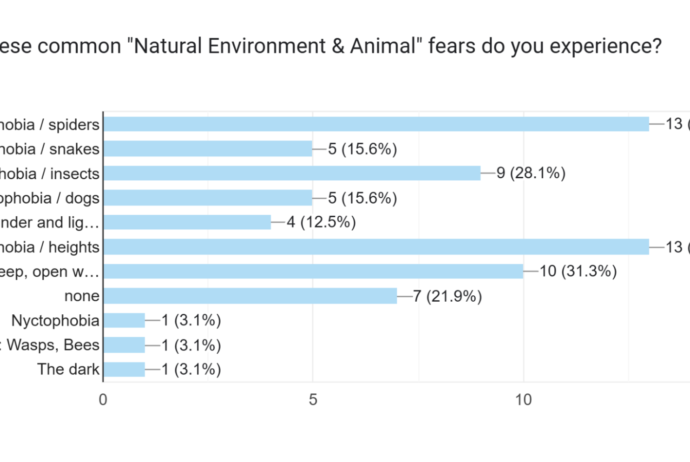
What do spiders, deep water, realistic robots, and loose change have in common? They all made appearances in a schoolwide poll asking students to reveal their most irrational fears. Across 32 responses, students described everything from familiar fears, like heights and insects, to more unusual anxieties involving clusters of holes, submerged objects, and animatronics. Their answers also revealed a common theme: fear isn’t always about how dangerous something actually is. Sometimes, it’s about uncertainty, losing control, or the way the brain interprets a possible threat.
32 students rated how fearful they consider themselves on a scale of 1 (not at all) to 5 (very fearful). Seven of the 32 respondents (22%), selected a 4 or 5, while four (12.5%), selected a 1. The remaining 21 students rated themselves a 2 or 3. The poll included common phobias such as heights, spiders, insects, snakes, the dark, and deep water, alongside situational fears involving needles, public speaking, tight spaces, and being alone.
Fear of the dark was a recurring theme in the written answers. One anonymous senior offered a detailed explanation: “[I’m afraid of] The dark because I don’t have a sense of what is there… when I’m in the dark, my brain panics because my eyes aren’t working.” The student continued by emphasizing that darkness can intensify other fears when they feel their vision isn’t reliable. Lizzy VanKuyk ‘28 expressed a similar idea, saying, “I think it’s just the fear of what’s in the dark and not the actual darkness itself.”
There’s a scientific explanation for why uncertainty can feel frightening. Vision helps people understand their surroundings and identify threats. When visibility is eliminated, the brain has less information to work with, making it harder to determine if something is safe.
Some of the poll’s most distinctive responses included fears that are difficult to explain to someone who doesn’t experience them. Finnley Brennan ‘30 identified animatronics as her biggest irrational fear, particularly those found in Halloween stores: “no matter how logical I am, every time I see one of [the Halloween store animatronics], I get super uncomfortable,” she wrote. She connected the fear to a childhood experience and also to the odd feeling of seeing something that looks human but isn’t. Jaiden Lui ‘28 shared a related fear, writing, “I’m terrified of robots that look human.”
Another freshman described a fear of clusters of holes, saying they “hate seeing multiple of the same thing at once, it looks uncanny and wrong.” One hyper-specific phobia was argyrophobia, the fear of silverware, jewelry and coins. The responder stated that they are “very repulsed by coins and can’t explain it.”
Reading this, you might be wondering: why does fear feel so physical? In reality, fear isn’t just a thought; it prepares a person to react to possible danger. The heart can beat faster, muscles could tense, palms can sweat, and a person may feel an urge to escape or freeze. The variety of these reactions appeared throughout the poll. Harper Acornley ‘30 described experiencing fear around heights and tight spaces. “When I’m high up my legs begin to shake and I get extremely light headed,” she wrote. She also described feeling trapped in small spaces. Mimi Benetos ‘27 explained that her fear of heights depends on how safe she believes a situation to be, stating, “[If] I’m somewhere where I know my life isn’t particularly in danger, I’ll be okay, but if I realize that something bad can happen if I’m high up somewhere, my body tenses up.” Her response shows how someone’s perception of danger can influence fear.
For Luc Lacroix ‘28, needles are frightening for a different reason, expressing, “It’s not the pain of being poked at; it’s the fact that you’re watching something foreign enter your body.” That statement highlights how fears can center on more than physical pain. Anticipation, uncertainty, and a feeling of losing control can all contribute to anxiety.
Meanwhile, Ben Thomas ‘30 was more direct about his fear of bugs: “I understand they are mostly harmless, but when I see most bugs, I scream,” underscoring the fact that irrational fears can be terrifying, no matter how harmless.
The poll revealed that irrational fears can be very specific, but the feelings and reasons behind them overlap. For some students, the explanation lies in a childhood memory or a film; for others, there’s no obvious reason at all. Either way, knowing that a fear is irrational doesn’t necessarily make it disappear. Ultimately, the poll is a reminder that fear is personal. One person’s harmless spider, ordinary needle, or silly-looking animatronic may be another person’s worst nightmare. And, if a Spirit Halloween animatronic ever appears in the middle of class, Finnley might appreciate a little warning.