Sem Balances Safety and Normalcy 

Ms. Miller’s fall ’25 Journalism class

A report of the recent school shooting in Colorado made its way to Kingston, Pennsylvania, and hit close to home. Even though it was 1,600 miles away, student talk began almost immediately. Conversations started about safety at SEM–the community inquiring about lockdowns, and posing questions we’d rather not have to consider. 

Private schools like Wyoming Seminary are statistically less vulnerable to gun violence than public schools. Between 2000 and 2018, researchers monitored 134 school shootings on or close to K–12 campuses with students in session. There were 122 in public schools yet just eight in private, about 6% to 94%. Data from the National Center for Education Statistics (NSEC) tells the same story: nearly 20% of public school students identify gang activity at their schools, compared to just 2%. Violent behavior like assaults and fighting also occurs less than half the time than it does in private schools. This fact mainly owes itself to class size, adult supervision, and school climates that foster respect and responsibility. 

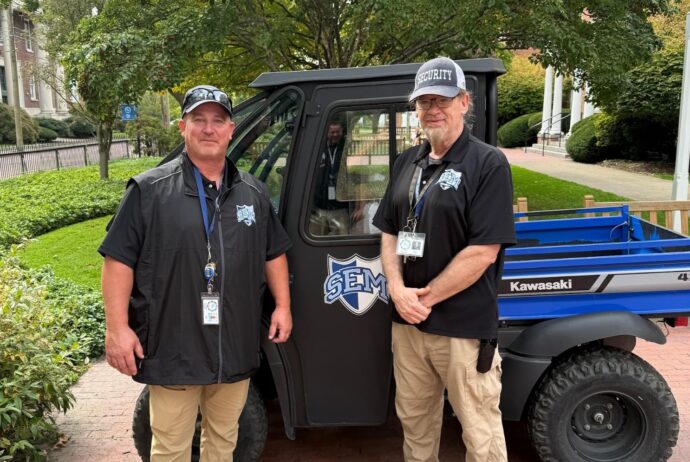
Fewer threats, though, does not mean threatless. Sem’s security is systematic: doors that require key cards, personnel patrolling the corridors, and regular emergency drills that involve local authorities. Lockdowns and evacuations take place all year round — not because of news headlines, but to make preparation second nature. The head of school at Wyoming Seminary, Martin Mooney, explains how “we have one or two shelters in place drills, evacuation drills, and fire drills each term.” Campus police officers and CCTVs are involved as well: guards patrol the school throughout the day, watching gates, checking IDs when it’s appropriate, and providing first-response care in an emergency. These things don’t turn the campus into a fortress, but they turn the campus into a place where students can learn without large lingering fear. For most students, these changes do not restrict freedom, but enable it.

Students pay attention. “You feel safer knowing someone is patrolling the halls or doors are locked,” Billy Hall ‘26 said. The Colorado disaster also altered ordinary routines in little ways. Friends called each other more often. Conversations strayed from plans for Friday night to safety and mental health. Students inquired the administration about locking up classrooms or simply promised to look out for each other. 

Sem’s role now is to balance: keep the doors open, but stay alert. The statistics show that the private schools are safer, but alertness is still the best defense. Staying alert is not drills and locks—it is people keeping an eye on each other and looking out for one another. And at Sem, those little, ordinary steps can be the greatest defense.

Sem Rowing ‘25: A Season of Trials and Tribulations

By: Abby Ryu ‘26


Wyoming Seminary Rowing has had a rough journey these past few years. Coach-less and boat-less at the start of the 2024-2025 season, the team feared they wouldn’t be able to pull together. Nonetheless, the team persevered, training all throughout the winter on the school’s erg machines or in the weight room. Thanks to continued persistence and hard work by everyone; rowers, parents, and coaches, the team was finally able to make it onto the lake for the spring season.

Going in, both the team and Dr. Froelich still knew the season would not be “normal” and they were right. While the team was thankfully able to resolve the boat situation by continuing their previous partnership with Harvey’s Lake Rowing Club, they still lacked a coach. When the long search for a head coach failed to resolve this problem, Dr. Froelich offered to step up for the position. However, given the risks associated with being a water sport, the school would not allow brand new rowers on the water without the supervision of a familiar licensed professional. Even after the season was approved (with only returning rowers being allowed to participate), the team struggled to get spring practices up and running on a regular basis because of the sport’s unique reliance on weather. The team only started consistently rowing on the lake at the start of April. Initially planning to row three regattas, the team will have only rowed one (City Championships) by the end of the season due to their late start to practice. 

As far as specific goals for next year, second-year rower Claire Woo ‘27 hopes to “row in more races and get better at rowing in general.”. Franny Froelich ‘27, acknowledging the gap left by the many graduating seniors on the team, hopes to also “continue to support the team as a whole.” Considering the many trials successfully overcome by the team this past year and their strong crop of passionate underclassmen, Wyoming Seminary Rowing will certainly be a team to look out for next year!

Regardless of all the trials, the team has also encountered tribulations; nearly all 2024-2025 rowers returned and the team atmosphere remained positive in the face of uncertainty. Reflecting on the season, varsity rower Clare Griffin ‘25 said “Even though it’s been a very unconventional season, I’m really grateful we still have a chance to row. Our team chemistry is really good.” 


Wyoming Seminary Envirothon

By: Emily Lin ‘25

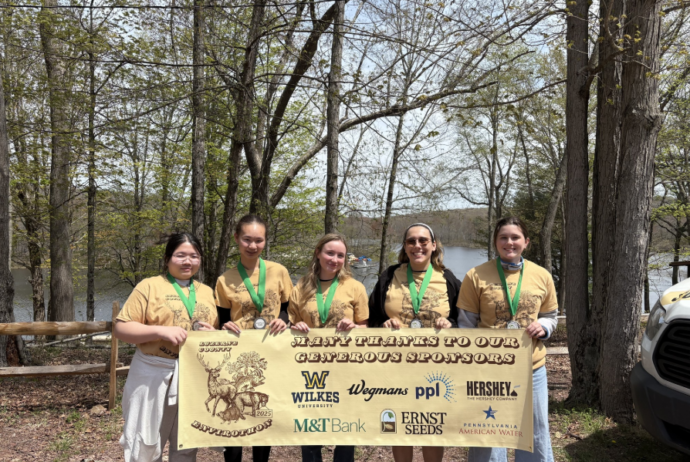
Envirothon is an annual competition that happens at Camp Kresge in White Haven, PA. The competition challenges students across five core disciplines: Aquatic Ecology, Forestry, Soils and Land Use, Wildlife, and a rotating Current Event, which for this year was, “Roots and Resiliency: Fostering Forest Stewardship in a Canopy of Change”. This year Wyoming Seminary sent a total of 3 teams: Team A, the “Woodcocks,” consisted of Gia Cella ‘25, Kaelee Potoski ‘25, Emily Lin ‘25, Gwen Simbar ‘25, and Eva Blaum ‘25; Team B consisted of Daisy Gao ‘28, Chi Ebi-Ekweozoh ‘25, Coco Kong ‘26, and Nicole Yang ‘26; Team C consisted of George Malloy ‘28, Thomas Li ’28, Kevin Yang ‘25, Ellie Hannon ‘26, and Moira Poepperling ‘25. In the months leading up to the competition, the teams worked together to study the five different topics, creating various study materials and engaging in weekly group sessions where they practiced applying their knowledge to real-world scenarios. 

The competition, which recently took place on April 29, 2025, gave students a chance to connect classroom learning with environmental issues and develop skills in problem-solving, fieldwork, and teamwork. They applied their preparation during the field-based event, completing practical assessments like identifying aquatic organisms, classifying soil types, and analyzing forest health. Through this process, students learned not only scientific facts but also gained a deeper understanding of environmental systems, the challenges facing modern ecosystems, and the importance of forest stewardship in the face of climate change. Team A member Eva Blaum ‘25 especially appreciates the opportunity Envirothon offers to be fully immersed in nature: “Envirothon has really helped me broaden my horizons of environmental knowledge. It’s really helped me see the beauty in all of Pennsylvania’s wildlife diversity and natural systems.” 

The team was wildly successful this year: Team A medaled, coming in second place, and will be going to states which will take place on May 21st at Windber Recreation Park. Gia Cella ‘25, also a member of Team A, when asked about the future “really encourages students to try [Envirothon] out. It’s a uniquely collaborative, informative, and interactive experience that I promise, you won’t regret!”