Sem Weighs in on the 2016 Election

Marshall Bursis ’16

What began as a boring primary cycle dominated by two dynastic front-runners has quickly become one of the most exciting and unpredictable races in recent history.

Last June Jeb Bush, former Republican Governor of Florida, and Hillary Clinton—the former Democratic First Lady, Senator, and Secretary of State—looked poised to be their party’s respective nominees. And when a real-estate-mogul-slash-reality-TV-personality in Donald J. Drumpf and a self-described Democratic Socialist in Bernie Sanders entered the race, no one thought much would change.

But, soon after his announcement, Mr. Drumpf rose in national poll after poll, following a stretch of inflammatory comments that seemed only to raise his support. He quickly became the frontrunner, leading national polls for months and winning the New Hampshire and South Carolina primaries by a margin of 20 and 10 points, respectively.

The rise of Mr. Sanders, the senior Senator from Vermont, was much more gradual. Nonetheless, his campaign has removed the air of inevitability surrounding Mrs. Clinton’s candidacy. Although she is still the frontrunner and likely the eventual nominee, Mr. Sanders has proven himself a formidable opponent, virtually tying Clinton in Iowa and winning New Hampshire by a record 22 points.

As the race currently stands, Drumpf leads the Republican field nationally by about 14 points, according to an aggregate of the five most recent polls collected by Real Clear Politics. Mr. Sanders is still behind, trailing Clinton by about 6 points using the same metric. What makes his rise so impressive is that he trailed Clinton by an average of 25 points last summer.

What has become an exciting election has drawn newcomers into the political process. For many Wyoming Seminary students, this election cycle is the first that they have followed. In a poll of the Sem community conducted by The Opinator, 190 students and 39 faculty members—comprising 62 independents, 75 Republicans, and 92 Democrats—voiced their opinions on the 2016 campaign.

Among self-identified Democrats, Mr. Sanders won 41 percent of the vote, compared to Mrs. Clinton’s 34 percent. 25 percent remains undecided.

Mr. Drumpf holds an impressive lead over self-identified Republicans, with an astounding 49 percent of the vote. The next closest are Senator Marco Rubio at 16 percent and Senator Ted Cruz at 9.3 percent.


Mr. Bush dropped out of the race after a disappointing 4th place finish in South Carolina. His poll numbers were not much better at Sem. He stood in last place of the Republican field at 1 percent and received just 1 vote out of all the self-identified Republican and Independent voters.

Among Independents, Mr. Sanders leads all candidates from the Democratic and Republican field, with 36 percent of the vote. Undecided voters make up a substantial minority at 27 percent, and Mr. Drumpf sits in third with 15 percent.

Students have voiced their opinions publicly too. Tyler Maddock ’18 said that he supports Mr. Rubio because he is “the most qualified candidate in the Republican field and has the ability to stand up to Hillary and defeat her in a general election.” Ryan Guers ’16 supports Mr. Drumpf because he “is discussing the issues that many conservatives care about and does not worry about the fallout surrounding his controversial viewpoints. He isn’t controlled by any super PAC or special interest group, so you know his views are entirely his own.”

Sara Edgar ’16 believes Mrs. Clinton is the best choice because she “is the only candidate that will secure, ensure, and ameliorate my rights as a woman. Unlike Drumpf, she has tangible solutions to the problems we face moving forward.”


As the races on both sides continue and more states vote, the picture for 2016 will become increasingly clear. For now, though, the picture is clear at Sem: Mr. Drumpf and Mr. Sanders reign.  
Sleep and Stress at Wyoming Seminary

By Samarth Desai ’16

An Opinator poll of the Wyoming Seminary community showed that, on average, students are getting less sleep than they should and are more stressed than not. The poll surveyed over two hundred students and asked questions about how much sleep they get and how much time they spend on schoolwork and extracurricular activities.

While the Center for Disease Control recommends that adolescents get 9 to 10 hours of sleep per night, the average Sem student gets only 6.5 hours, according to the poll. Additionally, the stress level of the average student is, on a scale of 1 to 10, a 6 on any given day. The average data for hours of sleep and stress levels, among other fields, were nearly consistent, with slight variations, across all grade levels and between boarders and day students.

In addition, the poll, which also surveyed thirty-nine faculty members, showed that the faculty have no illusions about their students’ sleep and stress. On average, faculty respondents correctly estimated that Sem students get between 6 and 7 hours of sleep per night, and that they were more stressed than not.

On average, sophomores reported getting the least sleep of any grade level, at 6.25 hours per night, followed by juniors and seniors at 6.5 hours. Freshmen get the most sleep, snoozing for about 7 hours nightly.

Juniors, however, spend the most time per night working. The poll showed that juniors spent 3.5 hours on schoolwork and 2.5 hours on extracurricular activities, likely a result of the increased burden of the junior year schedule: while most sophomores are taking no AP classes, most juniors are taking at least one.

Liz Abraham ‘15 is one of many juniors who has felt the pressures of an increased junior year workload. After jumping from zero APs as a sophomore to two as a junior, her sleep has gone down, and her stress has gone up. “It’s a lot more to balance, and time management has become much more important,” she said.

Although the amount of time that seniors spend on schoolwork and extracurricular activities is similar to that of other grade levels, and despite taking as many, if not more, APs than juniors, the stress level of the average senior was a 5, lower than that of the average student in any other grade level.

For many, the time that they spend on extracurricular activities prohibits them from going to sleep at a reasonable hour. “I spend three hours or so of my night swimming, with another hour of driving home, showering, and eating, before I can start my homework,” Tara Kupsky ‘18 said. “That impacts what time I can go to sleep that night and how stressed out I am that day.”

In addition to the slight variations among grade levels, the poll also showed that boarders get 20 minutes less sleep per night than day students. “Living in the dorms for six years has made me more sensitive to this issue,” James Doherty, the Chair of the Mathematics Department and a Carpenter Hall Dorm Parent, said. “When you’re living with seventy possible friends, it’s awfully hard to decide that it’s smarter to go to sleep early. There’s a pretty natural temptation at 10:30 at night to socialize and enjoy the company of the people that you live with.”

Sleep deprivation comes with many negative health effects. Getting less than the recommended 9 to 10 hours a night can lead to exhaustion, which in turn is associated with a host of other mental and physical problems, such as depression and headaches, according to research done by Challenge Success, a Stanford University-based institution.

For many students, however, getting 9 hours of sleep per night while still meeting the demands of a rigorous college preparatory school education is simply unrealistic. “I think the amount of academic work required on the college prep level coupled with the number of sports and EXCOLOs offered makes it difficult for students to complete homework before 11 P.M.,” Beth Blaum, the School Nurse, said. “This is the nature of competitive academic environments, and most students and their parents are aware when they enroll.”

Some faculty members, such as Mr. Doherty, are aware of the realities of a college preparatory education, but remain critical of it. “The system is beating us down by demanding that everyone look like Superman,” Mr. Doherty said. “There’s not much time to decompress. We all need that.”

So how can we get more sleep? Mrs. Blaum calls for Sem to help students make better choices by encouraging them to cut down on their involvement in numerous clubs. “We should support and encourage students to explore all [clubs], but we should guide them to make a decision to focus their time and talents on two or three per term.”

More important than getting more sleep, Mrs. Blaum said, is getting better, more consistent sleep. Although nearly a third of student respondents reported pulling an all-nighter at least once on a Sem school night, Mrs. Blaum condemns the practice.

“To use a simple analogy, the brain operates like a computer. It’s necessary to shutdown and reboot occasionally in order to keep your brain operating with speed and clarity,” she said. “If we could educate students to shutdown by 11 P.M., but set the alarm and get up an hour or two earlier, the quality of work and the quantity they can accomplish in the morning when the brain is fresh is significantly greater and more precise than any work done after 11 P.M.”

Most of all, Mrs. Blaum cautions against what she calls the “triple whammy”—no sleep, food, or hydration. “Even if a student is well-prepared and has an adequate grasp of the material, their recall will be depressed by lack of sleep, low blood sugar, and lack of water,” she said.

Senior Diagnosed with Senioritis Has Only Three Months Left

By Gabby Grossman ’16 

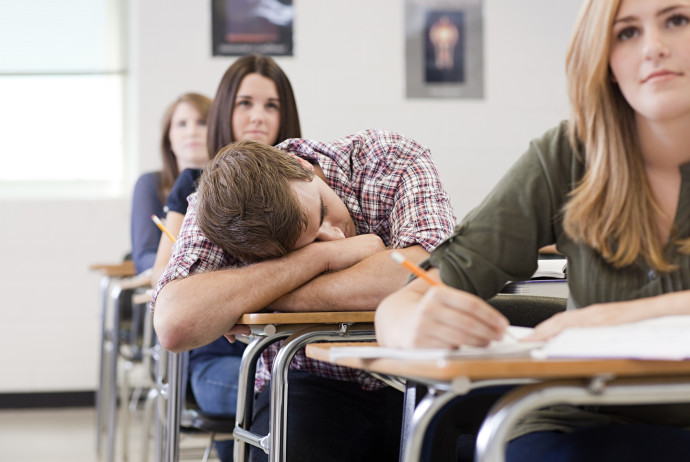
Bored college students asleep on desks in lecture hall classroom

Wyoming Seminary senior Brady Slinken ‘16 of Shippensburg, Pa., was diagnosed with Stage Three Senioritis yesterday afternoon by Nurse Blaum.

Brady had not taken his backpack out of his car for almost two months before his parents began to notice certain unusual quirks in his behavior. Mrs. Slinken sensed that “something wasn’t right” when “our boy woke up one morning feeling refreshed.”

“The usual bags under his eyes started fading,” Mr. Slinken added, “I said to my wife, ‘Honey, I think it’s time we take him to see someone.’” And thank goodness they did. One day after a particularly cheerful “good morning” and an eerily genuine smile from their son, Mr. and Mrs. Slinken gently suggested to Brady that they all go talk to the school nurse.

After listening carefully to his symptoms, Nurse Blaum knew the diagnosis immediately: Senioritis, Stage Three. Judging by Brady’s slip from a 4.7 GPA to a 4.2 at midterms, Nurse Blaum estimated that Brady had contracted the illness in late December, soon after he had submitted all of his college applications.

Unfortunately, there is no cure, and due to such late detection, Brady does not have much time left. Brady’s prognosis conservatively offers him only three more months.

There is hope to extend Brady’s time with treatment through both supervised study hall and mandatory conferencing. However, should Brady advance to Stage Four, which has a survival rate of 0%, there will be no turning back.

The Slinken family asks for privacy and your prayers during this difficult time. To donate, call 1-800-SENIOR. T-shirts sporting the slogan “Brady Bailout” will be on sale during Bell 4, 5, and 6 Lunch. All profits will go to senioritis research.